Free Delivery: 


Our facilities are now open for visits. Please contact your PIC or email us at contact@custommadepackaging.com to request a visit.
Free Delivery:
Home – Blogs – How Much Do Cosmetic Boxes Cost? 2026 Pricing Guide
 – Blogs
by Custom Made Packaging Team – October 25, 2026 · 15 min read
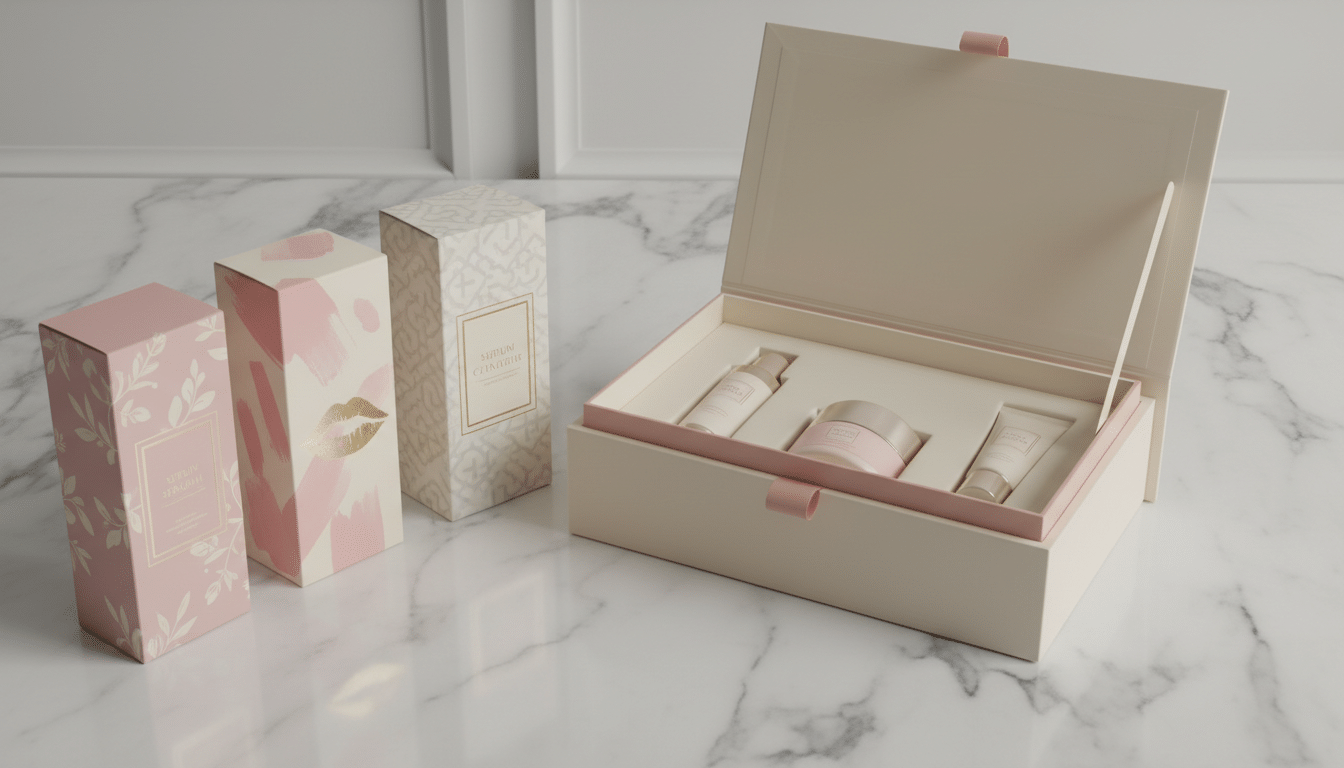
Custom cosmetic boxes can cost as little as $0.30 per box for a simple printed folding carton, while premium rigid gift boxes with foil, embossing and fitted inserts start around $3 per box and go up from there. Where your packaging lands in that range depends on eight things: quantity, size, box style, board, print method, finishes, inserts and timeline. Once you understand how each one moves the price, you can design cosmetic boxes that look expensive without paying more than you need to.
This guide breaks down what drives the cost of cosmetic packaging in 2026, compares box styles, materials and finishes side by side, gives realistic budget guidance for skincare, makeup, fragrance and gift sets, and shares practical ways to save. It is written for small and mid-size beauty brands, from indie skincare makers in the United States to clean beauty start-ups in Canada, that want a clear picture before they request a quote.
We also cover the labeling rules in the USA and Canada that shape your box layout, because the space you need for ingredients, net quantity and bilingual text affects size, design and ultimately price.
Table of contents: Cost at a glance · 8 price factors · Box styles compared · Materials · Printing and finishes · Quantity and unit price · Budgets by product type · Ways to save · USA and Canada · Budget checklist · Mistakes to avoid · How to order · FAQ
There is no single price list for custom packaging, because every quote is built around your exact size, quantity and artwork. What you can know in advance is the starting point for each type of box and roughly where premium upgrades push the price. The table below shows our starting prices for the box types beauty brands use most often. Starting prices apply to simpler specifications at higher quantities; small runs, large sizes and premium finishes increase the unit price.
| Packaging type | Starting price per unit | Typical use in beauty |
|---|---|---|
| Cosmetic boxes (printed paperboard) | From $0.30 | Serums, creams, lipsticks, foundations, mascaras |
| Product boxes (tuck end, sleeve, window) | From $0.80 | Retail cartons for larger or heavier items |
| Kraft boxes | From $0.50 | Natural, vegan and minimal-waste brands |
| Mailer boxes (corrugated) | From $0.90 | E-commerce orders, PR kits, subscription boxes |
| Rigid boxes | From $3.00 | Luxury skincare sets, fragrance, holiday gift sets |
| Custom labels | From $0.30 | Jars, bottles and tubes inside the box |
For most indie and growing beauty brands, the sweet spot is a printed paperboard carton with one premium finish. It protects the product, carries all required label information and looks at home on a boutique shelf or in an unboxing video. You can browse styles and specifications on our custom cosmetic boxes page.
Every quote for cosmetic packaging is a combination of the same building blocks. Understanding them helps you decide where to spend and where to simplify.
Printing and die-cutting involve setup work: preparing plates or digital files, making the cutting die and calibrating the press. That setup cost is roughly the same whether you order 100 boxes or 5,000, so the more boxes you order, the lower the cost of each one. Small runs are perfect for launches and testing, but expect a higher unit price.
Larger boxes use more board, and board is sold by the sheet. A box that fits two blanks on a press sheet instead of three costs noticeably more per unit. Trimming a quarter inch (about 6 mm) off an oversized carton can sometimes let more blanks fit on each sheet.
Simple styles such as reverse tuck end cartons are quick to cut, fold and glue. Styles with auto-lock bottoms, windows, hanging tabs, sleeves or magnetic closures need extra material, extra steps or hand assembly, which adds cost.
Bleached paperboard, kraft board, corrugated E-flute and rigid chipboard each sit at a different price level. Thicker board feels more premium and protects better, but costs more and adds weight.
Full-color CMYK printing is the standard. Exact brand colors matched with Pantone (PMS) inks, printing on both sides, and inside printing all add to the price. Heavy ink coverage on dark designs can also need extra drying time and care.
Lamination, soft-touch coating, foil stamping, embossing, debossing and spot UV each add a production step. Some, such as foil and embossing, also need their own tooling.
Cardboard, paperboard or foam inserts keep bottles upright and stop jars from rattling. They improve protection and presentation but add material and assembly. Our guide to packaging inserts explains the main options.
Rush production compresses scheduling and can cost more with many suppliers. Freight is another hidden line item in many quotes. With Custom Made Packaging, shipping is free to anywhere in the USA and Canada, so the price you are quoted is the price you pay to get boxes to your door.
| Cost factor | Impact on unit price | How to control it |
|---|---|---|
| Quantity | Very high | Order enough for several months if your design is stable |
| Box style | High | Use tuck end cartons for everyday SKUs, rigid boxes only for hero sets |
| Material | High | Match board thickness to product weight, not to habit |
| Finishes | Medium to high | Choose one signature finish instead of stacking several |
| Size | Medium | Size snugly around the product and insert |
| Printing | Medium | Use CMYK unless an exact brand color is essential |
| Inserts | Medium | Use paperboard inserts for light items; reserve foam for fragile glass |
| Timeline | Low to medium | Plan ahead so you can use standard turnaround |
The style you choose sets the baseline for your cosmetic packaging budget. Here is how the most common styles compare, from the most economical to the most premium:
| Box style | Relative cost | Best for | Notes |
|---|---|---|---|
| Reverse or straight tuck end | $ | Serums, lipsticks, mascaras, tubes | The most economical carton; ships flat |
| Auto-lock (crash) bottom | $$ | Heavier jars and bottles | Stronger base, quicker packing |
| Window box | $$ | Lip glosses, palettes, bath products | Shows the product; film window adds a step |
| Sleeve and tray | $$–$$$ | Gift sets, palettes, sample kits | Premium slide-out reveal |
| Display box | $$ | Counter displays for lip balms and minis | Great for boutiques and pharmacies |
| Corrugated mailer | $$ | Online orders, PR boxes, subscriptions | Ships directly without an outer carton |
| Rigid lid and base or magnetic | $$$$ | Luxury skincare, fragrance, holiday sets | Hand-wrapped chipboard; ships assembled |
One cost brands often forget with rigid boxes: they are shipped and stored already assembled, so they take up much more space than flat-packed cartons. If you are deciding between the two, our comparison of rigid boxes vs folding cartons goes deeper on when each makes sense. For premium sets, see our custom rigid boxes.
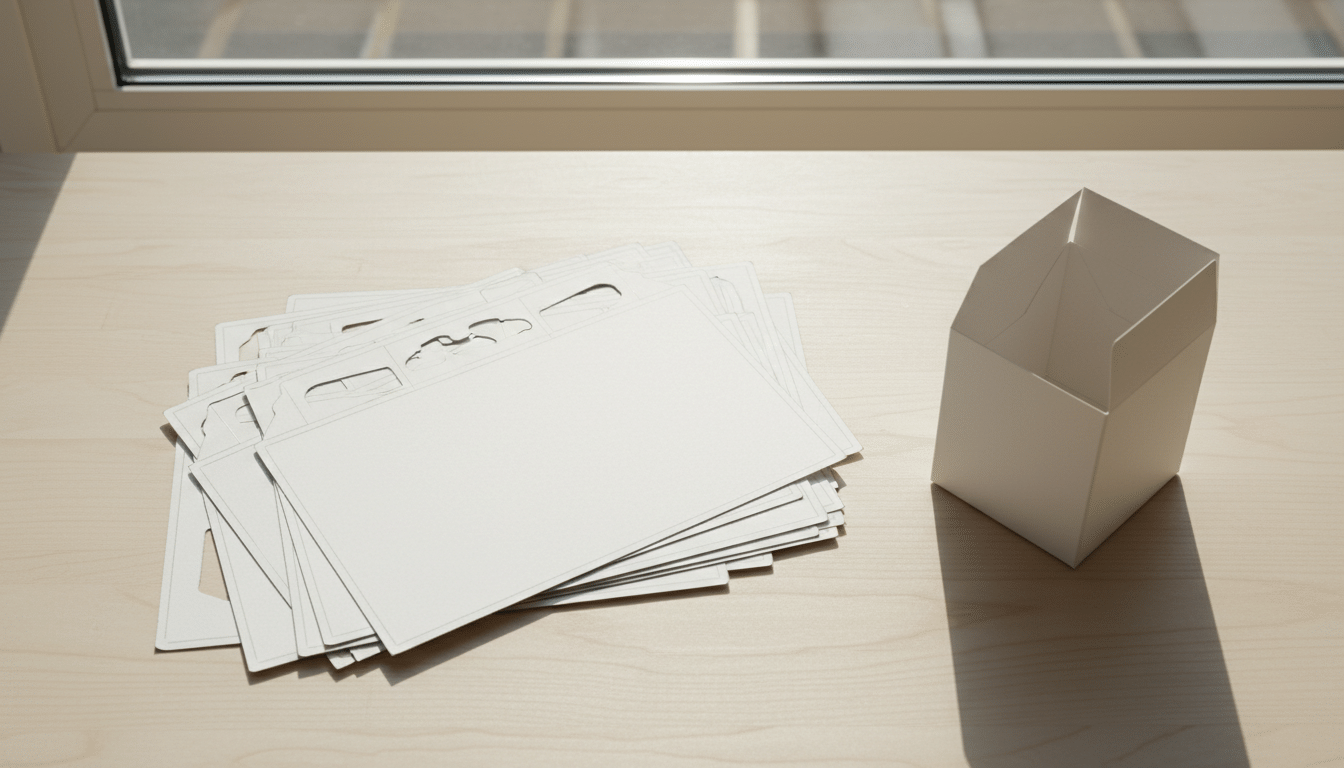
Material is the second biggest lever on price after quantity. Paperboard thickness is usually measured in points (pt), where one point equals one thousandth of an inch (0.001 inch, about 0.025 mm). Rigid board is much thicker and is usually described in millimeters.
| Material | Typical thickness | Relative cost | Look and feel | Best for |
|---|---|---|---|---|
| White paperboard (SBS) | Commonly 14–24 pt (about 0.36–0.61 mm) | $ | Bright, smooth, excellent print quality | Most skincare and makeup cartons |
| Kraft paperboard | Commonly 14–24 pt | $ | Natural brown, earthy, minimal | Clean, vegan and eco-focused brands |
| Corrugated E-flute | About 1/16 inch (1.5 mm) | $$ | Sturdy, printable, lightweight | Mailers, heavier glass jars, kits |
| Rigid chipboard wrapped in paper | Commonly 1.5–3 mm (about 1/16–1/8 inch) | $$$$ | Heavy, solid, luxurious | Fragrance, luxury sets, gifting |
A useful rule of thumb: a 1 oz (30 mL) serum bottle is well served by a mid-weight paperboard carton, while a heavy 1.7 oz (50 mL) glass cream jar or a multi-item set benefits from thicker board, an insert, or both. If sustainability is part of your brand story, kraft boxes start from $0.50 and are made from recyclable kraft stock.
Finishes are where cosmetic boxes earn their shelf appeal, and also where budgets most often drift. Each finish adds a production step, and some need custom tooling. Here is how the most popular options compare:
| Option | What it does | Cost impact |
|---|---|---|
| CMYK full-color print | Reproduces photos, gradients and most colors | Included in base price |
| Pantone (PMS) spot color | Matches an exact brand color consistently | Low to medium |
| Gloss or matte lamination | Protects print from scuffs and moisture | Low |
| Soft-touch coating | Velvety feel associated with premium skincare | Medium |
| Spot UV | Glossy highlight on a logo or pattern | Medium |
| Foil stamping (gold, silver, rose gold) | Metallic shine on logos and borders | Medium; needs a stamping die |
| Embossing or debossing | Raised or pressed-in texture | Medium to high; needs a die |
| Inside printing | Pattern or message revealed on opening | Medium |
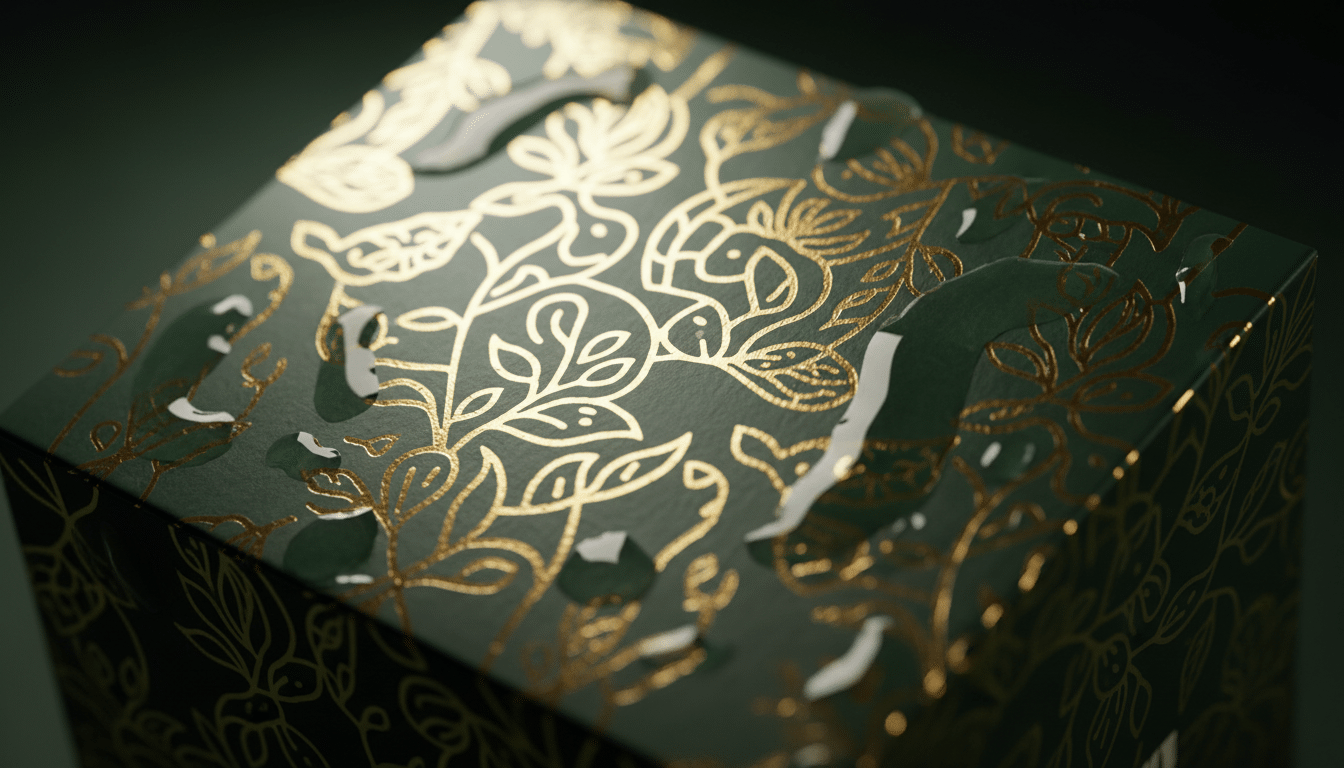
If your artwork is not print-ready yet, color mode matters too. Files built in RGB for screens can shift when printed in CMYK, so always review a proof. Our team checks every file for bleed, resolution and color before production as part of our free design support, and if you want a full brand look created from scratch, you can work with a professional packaging designer.
Quantity is the single biggest driver of unit cost. A small run carries the same press setup, die and finishing setup as a large one, so those fixed costs weigh heavily on each box. As quantities grow, they shrink to a fraction of a cent per box, and material buying becomes more efficient.
That does not mean you should always order thousands. For beauty brands, the right quantity balances unit price against real-world risks:
A practical approach is to start with a small run, as low as 30 boxes with us, to validate the design and fit, then move to larger orders once the product and artwork are stable. Our custom packaging for small business guide covers how to plan quantities as you grow.
Different beauty categories have different packaging needs. Here is where brands usually spend and save in each:
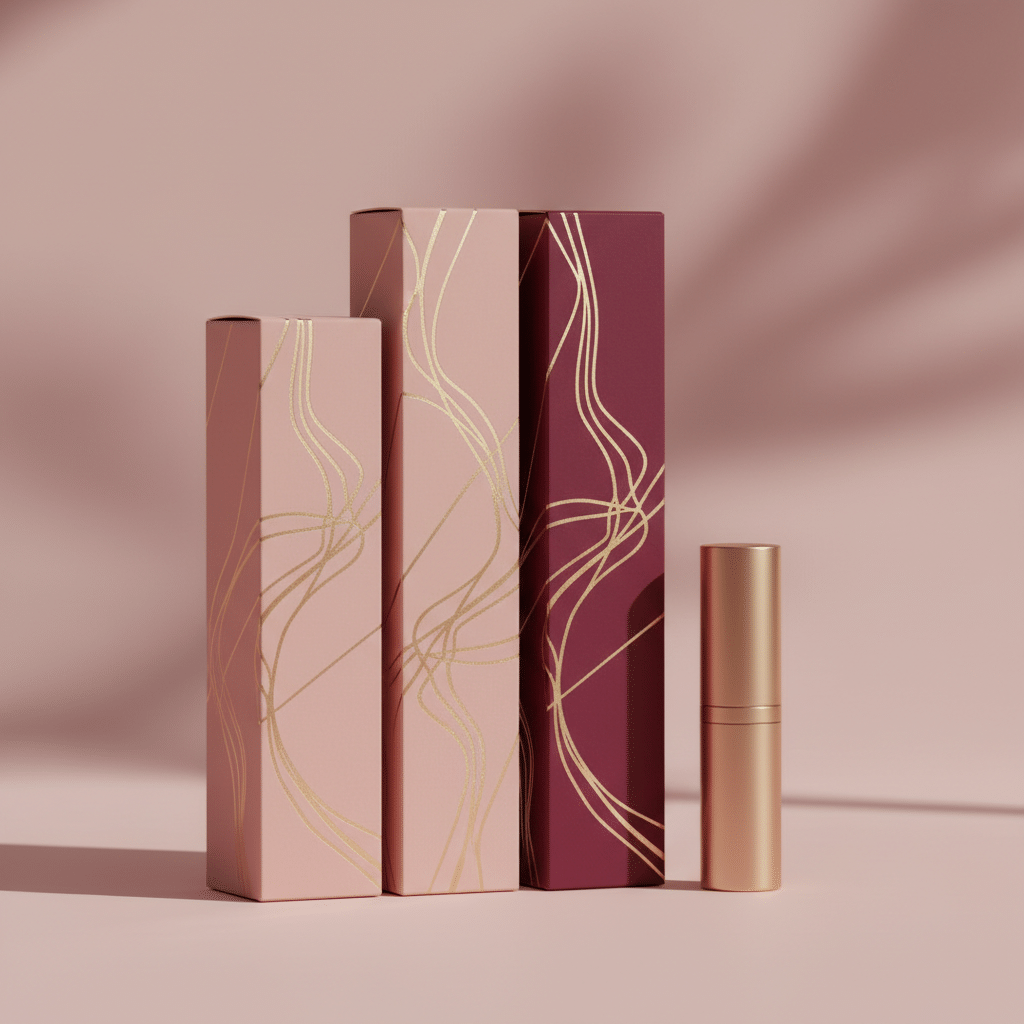
Skincare cartons need room for detailed directions and full ingredient lists, which often pushes brands to a slightly larger box than the bottle alone requires. Paperboard tuck end boxes with matte lamination or soft-touch coating are the most common choice. Spend on a paperboard insert for glass droppers, and save by keeping the print to two or three colors.
Lipstick and mascara boxes are small, so they use very little board. That makes them one of the most affordable places to add foil or embossing, because the extra cost per box stays low. Palettes and foundations often benefit from window boxes or sleeves that show shade colors.
Fragrance packaging is expected to feel luxurious, and heavy glass bottles need real protection. Many brands use rigid boxes with fitted inserts for full-size bottles and printed paperboard for travel sizes and roll-ons.
Larger bottles and tubs mean larger boxes. Many haircare brands skip a retail carton entirely and invest in high-quality custom labels on the bottle, then ship in a branded mailer. For bath products, dedicated bath bomb boxes start from $0.50.
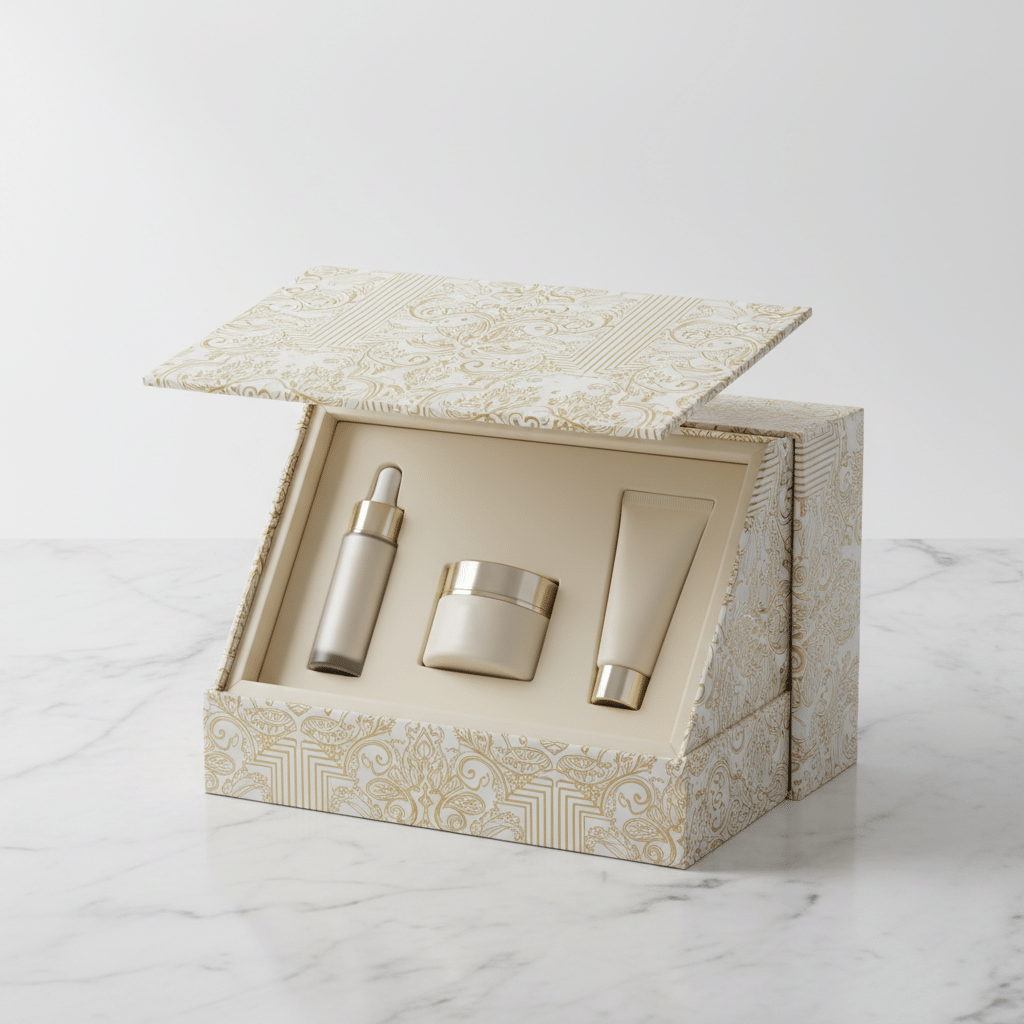
Gift sets are where rigid boxes and custom inserts pay off. Because these boxes sell at higher price points and are often photographed and shared, the packaging can justify a larger share of the product cost. PR kits that ship to influencers usually go in printed custom mailer boxes with inside printing, which protect the contents and create a memorable reveal. Our mailer box sizes guide helps you pick the right dimensions.
| Product type | Common box choice | Where to spend | Where to save |
|---|---|---|---|
| Serum or face oil | Tuck end paperboard | Insert for dropper bottle | Limit colors, skip window |
| Moisturizer jar | Auto-lock bottom carton | Sturdier board | Standard lamination |
| Lipstick or gloss | Slim tuck end | Foil logo | Single-side print |
| Eyeshadow palette | Sleeve or window box | Shade-accurate printing | Simple construction |
| Fragrance | Rigid box with insert | Premium wrap and finish | Paperboard for travel sizes |
| Gift set | Rigid or sleeve and tray | Fitted insert | One signature finish only |
Pro tip: Ask for two quotes on the same request: one with your dream finishes and one with a single signature finish. Seeing the difference side by side makes it much easier to decide which upgrades are worth it for each SKU, and many brands end up using the premium version only for their best-seller or gift set.
We make custom cosmetic boxes for beauty brands across the United States and Canada, with free shipping to both countries. The two markets share many expectations, but labeling and shipping differences can change how much panel space you need and how you size your boxes. This section is general guidance, not legal advice; always confirm current rules with the relevant regulator or a compliance specialist before you print.
Cosmetics sold to consumers in the US fall under FDA oversight. Retail cosmetic packaging generally needs a product identity, net quantity of contents, an ingredient declaration and the name and place of business of the manufacturer, packer or distributor, along with any required warnings. Net quantity is typically shown in both US customary and metric units, for example 1 fl oz (30 mL), on the principal display panel. The Modernization of Cosmetics Regulation Act of 2022 (MoCRA) added further requirements, including contact information for adverse event reporting, so check the latest FDA guidance when you design your label panel.
For direct-to-consumer brands, shipping matters too. UPS and FedEx bill many parcels by dimensional weight in inches and pounds, and USPS applies dimensional pricing to larger parcels, so a compact mailer around your cosmetic box keeps every order cheaper to ship.
Cosmetics in Canada are regulated by Health Canada, and manufacturers and importers are generally required to notify Health Canada about cosmetics they sell. Most mandatory consumer label information must appear in both English and French, and ingredient lists are expected on the outer label. Net quantity is shown in metric units. Bilingual text takes up noticeably more space, so many brands selling in Canada either choose a slightly larger carton, use a fold-out or peel-back label, or design a dedicated bilingual box.
Canadian carriers usually calculate volumetric weight in centimeters and kilograms, so measure in metric when you compare shipping rates. You can send us your box dimensions in inches or centimeters, whichever is easier.
| What matters | United States | Canada |
|---|---|---|
| Regulator | FDA | Health Canada |
| Label language | English | Most mandatory information in English and French |
| Net quantity units | US customary and metric, e.g. 1.7 oz (50 g) | Metric, e.g. 50 g or 50 mL |
| Panel space needed | Standard | More, to fit bilingual text |
| Shipping measurements | Inches and pounds | Centimeters and kilograms |
| Cost impact on boxes | Mostly driven by style, finish and quantity | Possible larger box or extra label for bilingual copy |
| Delivery from us | Free shipping | Free shipping |
If you plan to sell in both countries, designing one bilingual carton from the start is often cheaper than running two separate print jobs, because you avoid a second setup and keep one stock item.
Have a question about specifications before you request a quote? Contact our team and we will help you choose the right cosmetic box for your product and budget.
Printed paperboard cosmetic boxes start from about $0.30 per box, while rigid luxury boxes start from about $3. Your final unit price depends on quantity, size, style, material, finishes and inserts. Larger orders bring the price per box down because setup costs are spread across more units.
With Custom Made Packaging, you can order custom cosmetic boxes from just 30 units. Small runs are ideal for product launches, testing new designs or limited editions. The unit price is higher on small runs, and it drops as you order more.
Rigid boxes are made from thick chipboard wrapped in printed paper, which uses more material and often requires hand assembly. They also ship assembled, so they take up more space in transit and storage. The result is a sturdier, more luxurious box suited to gift sets and fragrance.
For many beauty brands, yes, when it is used with restraint. A foil logo on a matte or soft-touch box adds a premium cue for a modest extra cost, especially on small boxes like lipstick cartons. Covering large areas in foil raises costs faster than it raises perceived value.
Generally, yes. Most mandatory consumer label information on cosmetics sold in Canada must appear in both English and French. Plan the extra space early, as it can affect box size or require a fold-out label, and confirm current requirements with Health Canada.
US retail cosmetic packaging typically includes the product identity, net quantity in US customary and metric units, an ingredient list, the responsible company’s name and place of business, and any required warnings. Newer rules under MoCRA add contact details for adverse event reporting. Check the latest FDA guidance before you finalize artwork.
You receive a 2D and 3D digital mockup within 48 hours of ordering. After you approve the design, standard production takes 10–15 business days and rush production takes 8–12 business days, followed by free shipping to the USA and Canada.
A reverse tuck end box in white or kraft paperboard with standard CMYK printing is usually the most economical option. It ships flat, assembles quickly and still looks polished with a simple matte or gloss lamination. Adding one finish, such as a foil logo, keeps it affordable while lifting the look.
Get the custom quote starting from our MOQ of 30 boxes to any order volume. There will be no charges for shipping and we ensure the lowest prices with highest quality possible.