Free Delivery: 


Our facilities are now open for visits. Please contact your PIC or email us at contact@custommadepackaging.com to request a visit.
Free Delivery:
Home – Blogs – Cosmetic Boxes for Skincare: 2026 Design & Sizing Guide
 – Blogs
by Custom Made Packaging Team – October 30, 2026 · 18 min read
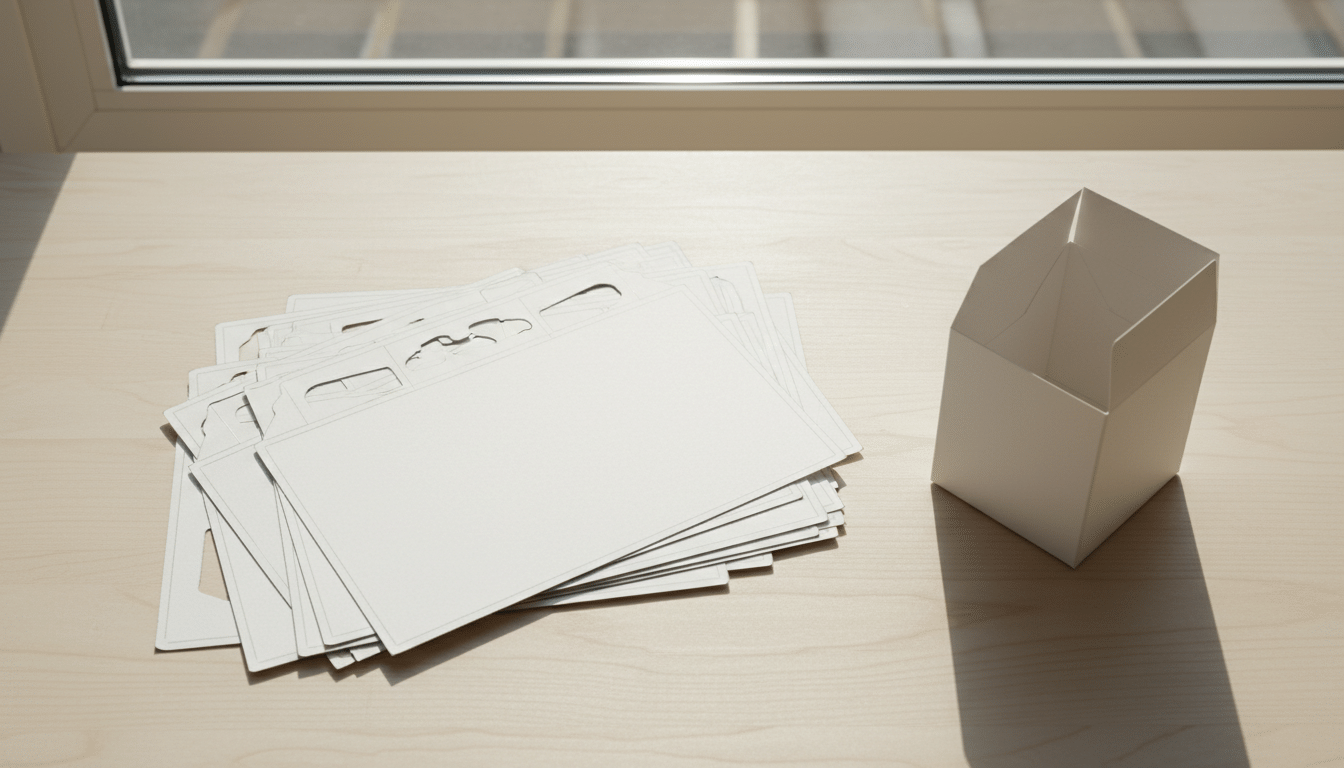
The best cosmetic boxes for skincare are snug-fitting folding cartons made from 16 to 24 pt paperboard, sized to the bottle, jar or tube with about 1/16 inch of clearance, printed with a calm, legible design and carrying every piece of label information your market requires. For most serums, creams and cleansers that means a reverse tuck end or auto-bottom carton; for gift sets and premium launches, a rigid box with a fitted insert. Get the size, structure, board and label panel right, and the design has room to do its job.
This guide is written for skincare founders and brand managers in the United States and Canada who are planning a first carton or replacing a stock box. You will learn which box styles suit which skincare formats, typical inside dimensions for common bottle and jar sizes, how to choose board and finishes, how to lay out the label panels, what changes between the US and Canadian markets, what drives price, and a step-by-step checklist to go from measurements to finished boxes.
Whether you sell a three-product routine from a home studio or a 40-SKU line through Shopify, Amazon and boutique spas, the same principles apply. If you want a broader look at beauty packaging first, our custom cosmetic boxes page shows the full range of styles we make.
Table of contents: Why skincare needs its own approach · Cosmetic box styles for skincare · Sizing cosmetic boxes for skincare containers · Paperboard, kraft and rigid board · Inserts for droppers, jars and sets · Designing skincare cosmetic boxes · Finishes and printing · Label panels and required information · Skincare boxes in the USA and Canada · Sustainable skincare packaging · Cost and pricing factors · Step-by-step checklist · Common mistakes to avoid · How to order · FAQs
Skincare sits in an unusual spot. The products are small, often glass, frequently expensive per ounce and bought by customers who read labels closely. A lipstick box can lean on bold color; a serum box has to communicate ingredients, routine step, skin type and trust in a few square inches. That changes how you should brief your packaging.
The good news is that all of this can be planned. Start with the structure and size, then the material, then the design and label content, rather than the other way around.
Most skincare cartons are folding cartons: single sheets of printed paperboard that are die-cut, creased and glued, then shipped flat and folded up when you pack. A few premium formats use rigid board. Here are the styles worth knowing and where each one fits.
| Box style | How it closes | Best for | Watch-outs |
|---|---|---|---|
| Reverse tuck end (RTE) | Tuck flaps at top and bottom, opening from opposite sides | Serums, droppers, tubes, single bottles up to about 4 fl oz | Bottom flap can open under heavy glass; add an insert if needed |
| Straight tuck end (STE) | Both tuck flaps open from the same side | Premium cartons where you want a clean front panel | Slightly more board than RTE |
| Auto-bottom (crash-lock) | Pre-glued bottom snaps into place; tuck lid on top | Heavy glass jars, larger pump bottles, faster packing | A little more expensive than tuck end |
| Sleeve and tray | A printed tray slides out of an outer sleeve | Masks, ampoule sets, discovery kits | Size tolerances matter so the sleeve does not slip off |
| Window box | Tuck end carton with a die-cut window and clear film | Products where texture or color sells, such as body scrubs | Keep fragile glass away from the window edge |
| Two-piece or magnetic rigid box | Lid and base, or a hinged magnetic flap | Gift sets, limited editions, PR boxes | Higher cost and heavier to ship |
| Counter display box | Open-top tray with a printed header | Retail checkout displays for minis and lip balms | Must be sturdy enough to hold product upright |
If you are unsure whether a premium launch needs a rigid box or a well-finished carton, our comparison of rigid boxes vs folding cartons walks through the trade-offs in cost, protection and presentation.
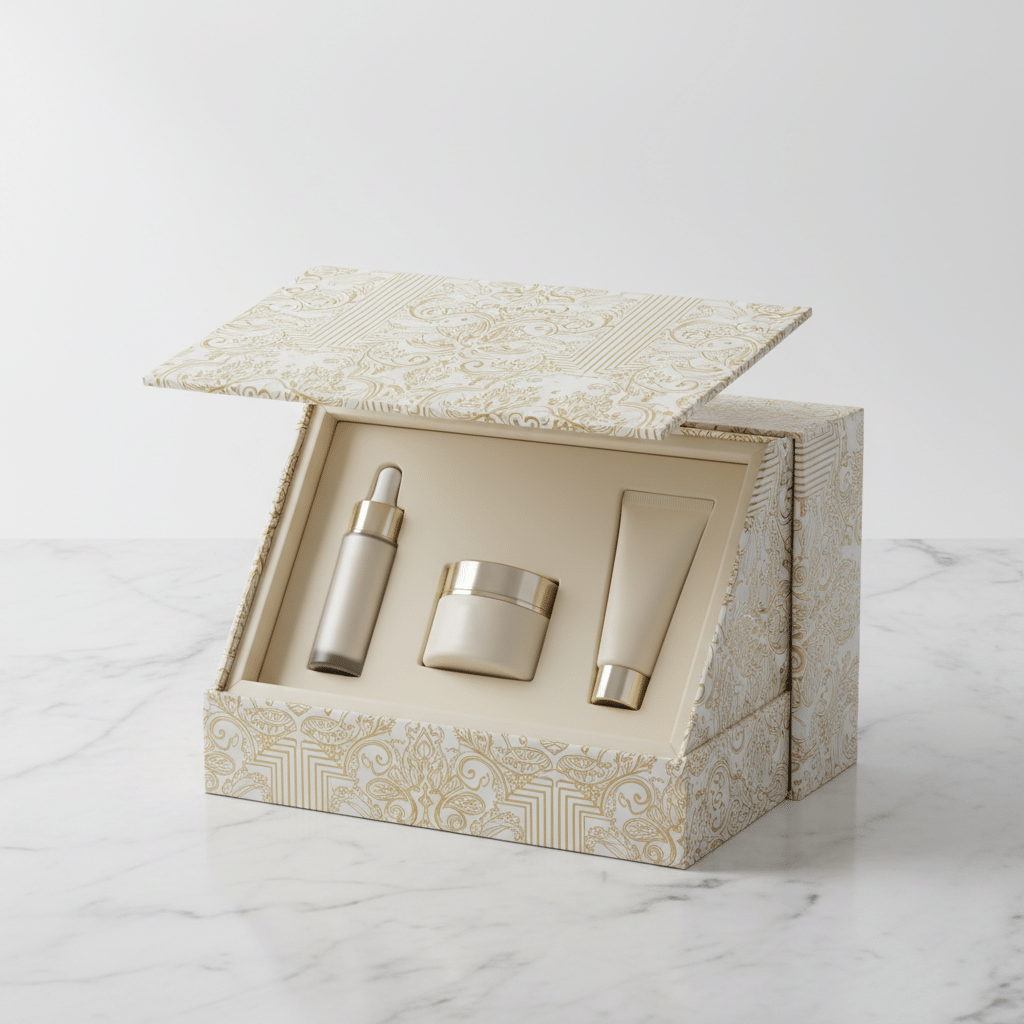
Sizing is where many skincare cartons go wrong. A carton that is too loose lets a glass bottle rattle and makes the product feel cheap; too tight and your packing team will scuff the print forcing bottles in. Custom boxes are specified by inside dimensions, written as Length × Width × Depth, where depth is the tall dimension for most upright cartons.
The table below gives typical starting inside dimensions for common skincare formats. Containers vary by supplier, so treat these as a planning guide and always size from your own component.
| Product format | Typical container | Starting inside size (inches) | Starting inside size (cm) |
|---|---|---|---|
| Lip balm or lip oil | 0.15 oz (4.25 g) tube | 0.75 × 0.75 × 2.9 | 1.9 × 1.9 × 7.4 |
| Face serum or oil | 1 fl oz (30 mL) glass dropper | 1.4 × 1.4 × 4.3 | 3.6 × 3.6 × 10.9 |
| Eye cream | 0.5 oz (15 mL) jar | 2.0 × 2.0 × 1.6 | 5.1 × 5.1 × 4.1 |
| Face moisturizer | 1.7 oz (50 mL) glass jar | 2.6 × 2.6 × 2.2 | 6.6 × 6.6 × 5.6 |
| Cleanser or sunscreen | 3.4 fl oz (100 mL) tube | 1.8 × 1.4 × 6.8 | 4.6 × 3.6 × 17.3 |
| Toner or lotion | 4 fl oz (120 mL) pump bottle | 1.9 × 1.9 × 6.6 | 4.8 × 4.8 × 16.8 |
If you ship cartons inside an outer shipper, keep a consistent footprint across products where you can. Two or three carton footprints make it far easier to design inserts and choose custom mailer boxes that fit a full routine without void fill. Our mailer box sizes guide explains how to size the outer box around your cartons.
The material decides how the box feels in the hand, how sharp the print looks and how well it protects the product. In North America, paperboard thickness is usually quoted in points (pt), where 1 pt equals 0.001 inch; some suppliers also quote grams per square meter (gsm).
| Material | Typical thickness | Look and feel | Best skincare uses |
|---|---|---|---|
| SBS (solid bleached sulfate) paperboard | 14–24 pt | Bright white, smooth, crisp print | Most serums, creams and cleansers; clean, clinical brands |
| Kraft paperboard | 16–24 pt | Natural brown, uncoated, earthy | Natural, botanical and refill-focused brands |
| Recycled paperboard (CCNB) | 16–24 pt | Gray back, white printed face | Cost-conscious lines with simpler print |
| Rigid chipboard wrapped in paper | About 1/16–1/8 inch (1.5–3 mm) | Heavy, premium, does not fold | Gift sets, launches, PR kits |
| E-flute corrugated | About 1/16 inch (1.5 mm) | Light and strong, good print | Shipping cartons, mailer-style sets |
As a rule of thumb, 16 to 18 pt suits light plastic bottles and tubes up to about 2 oz, 18 to 24 pt suits glass droppers and jars, and anything heavier than about 8 oz (225 g) benefits from an auto-bottom, an insert or a rigid structure. Kraft paperboard is popular with clean-beauty and botanical brands; our custom kraft boxes come with the same printing options as white board.
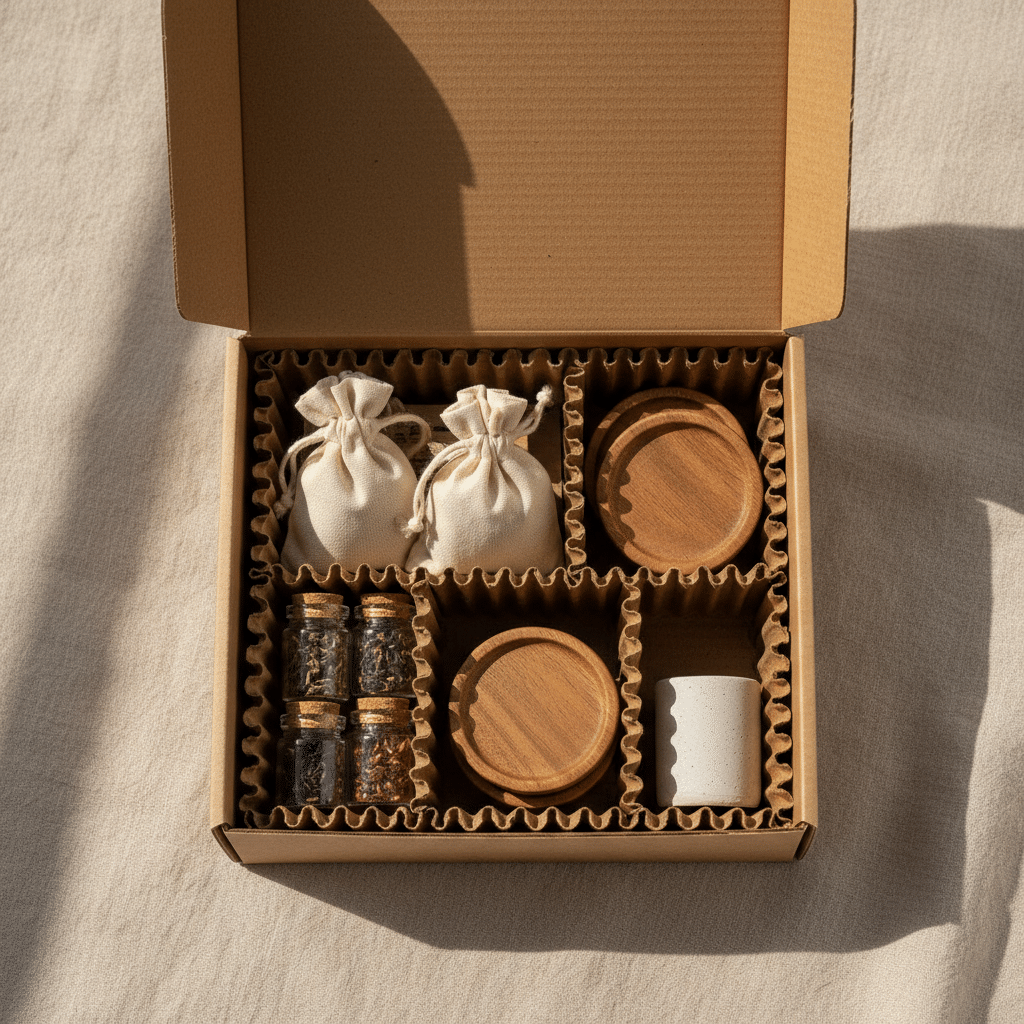
An insert is the cheapest insurance you can buy for glass skincare. It holds the product centered, stops it rattling, keeps the dropper upright and gives sets a polished, organized look.
| Insert type | How it works | Good for |
|---|---|---|
| Paperboard shoulder insert | A die-cut card with a hole that grips the bottle neck | Single dropper and pump bottles |
| Folded paperboard cradle | Folds into a platform with cutouts sized to each item | Routine sets of two to five products |
| Corrugated insert | E-flute partitions or cutouts | Heavier glass sets shipped by courier |
| Molded pulp tray | Pressed fiber tray shaped to the product | Eco-focused brands, heavier jars |
| Foam insert | Cut or molded foam | Very fragile glass; harder to recycle |
For a deeper look at materials and costs, read our guide on what packaging inserts are and when to use them. Paper-based inserts are usually the best fit for skincare brands that want curbside-recyclable packaging.
Skincare design rewards restraint. Customers compare products side by side and want to understand, in seconds, what a product does and whether it suits their skin. A clear hierarchy matters more than decoration.
Soft neutrals, sage, blush, sand and clean white dominate skincare because they signal calm and cleanliness, but contrast still matters. Light gray text on white board is hard to read in a bathroom and fails accessibility basics. Keep body text dark, use at least two weights of one typeface family, and reserve a single accent color to code each product type or routine step. If you use PMS spot colors for brand consistency, confirm them with a printed proof.
If you would rather hand the layout to a specialist, you can work with a professional packaging designer on custom design boxes, or use our free design support. For more visual inspiration across industries, see our custom design box ideas.
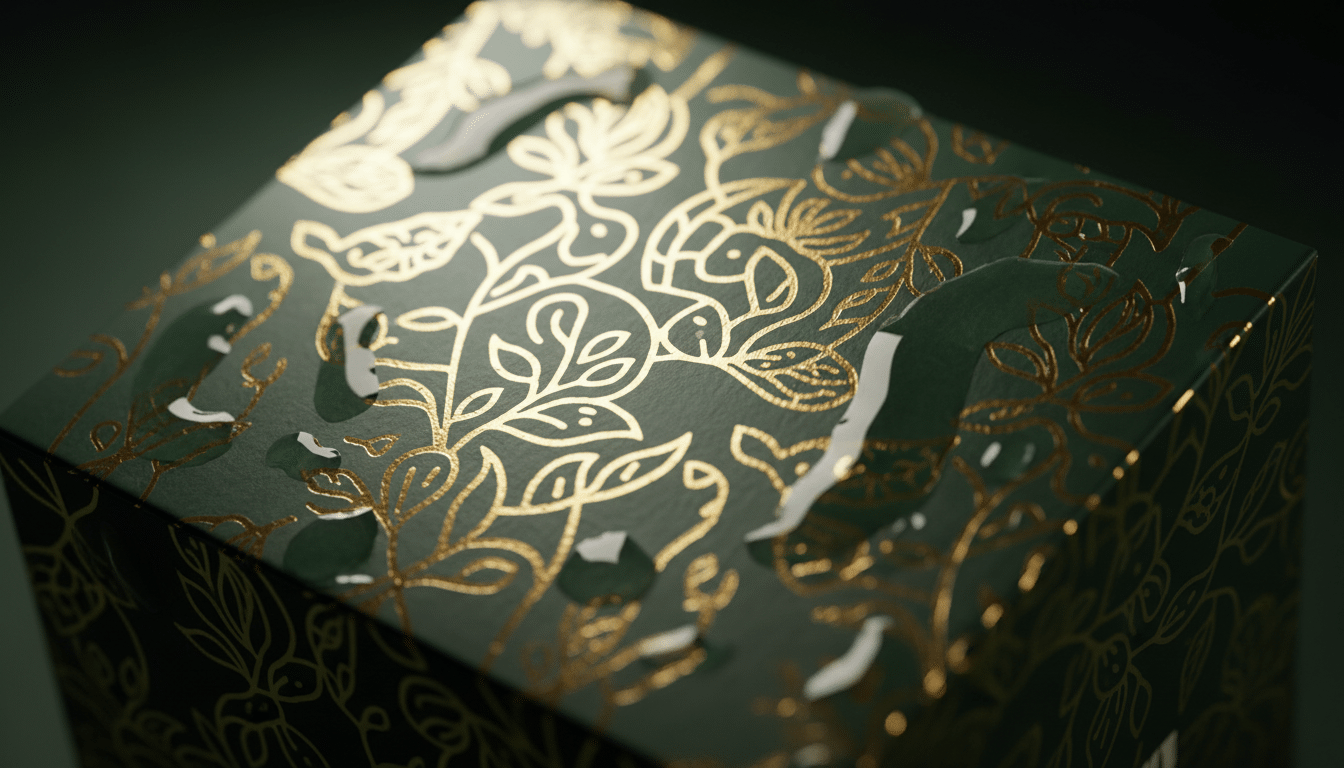
Finishes are where a skincare carton earns its price point. Use them deliberately: one well-placed finish usually looks more premium than three competing ones.
| Finish | Effect | When to use it in skincare |
|---|---|---|
| Matte lamination or aqueous coating | Soft, low-glare, velvety surface | Default for calm, modern skincare; resists fingerprints |
| Gloss lamination | Shiny, vivid color | Bright, youthful or fun brands |
| Soft-touch coating | Velvet or suede feel | Premium serums and night creams |
| Hot foil stamping | Metallic gold, silver, rose gold or holographic | Logo or product name only |
| Embossing or debossing | Raised or recessed texture | Logo or pattern; very effective on kraft |
| Spot UV | Glossy highlight on a matte background | Botanical motifs or a single focal word |
Print method matters too. Digital printing makes sense for short runs and many SKUs, while offset printing gives excellent color consistency on larger runs. Tell your supplier how many designs you have; it changes the most cost-effective method.
When a skincare product is sold inside a carton, the carton is usually the label regulators look at first. Plan the label panels before you finalize artwork so the design does not have to be squeezed later. Requirements change and vary by product claim, so treat the overview below as a planning checklist and confirm current rules with the relevant regulator or a regulatory consultant.
| Panel | What usually goes there | Design tip |
|---|---|---|
| Principal display panel (front) | Brand, product identity (what it is), net quantity | Keep the identity statement large and plain |
| Information panel (back or side) | Ingredient list, directions, warnings, business name and address | Reserve at least one full side for ingredients |
| Bottom or flap | Batch or lot code, barcode, recycling guidance | Leave a clear area for lot codes printed later |
| Inside of the box | Usage tips, brand story, thank-you message | Never put mandatory information only on the inside |
Products that make drug claims, such as sunscreens with an SPF, acne treatments or certain antiperspirants, are regulated differently in both countries and need a different label format. If any of your skincare products make these claims, get regulatory advice before you design the carton.
We make cosmetic boxes for skincare brands across the United States and Canada, with free shipping to both countries. The structure and printing are the same, but a few market differences affect sizing, labels and how you ship.
US cosmetics fall under the FDA, and the carton is typically expected to carry the product identity and net quantity on the front, with the ingredient list, directions, warnings and the name and place of business of the manufacturer, packer or distributor elsewhere on the box. Net quantity is generally expected in both US customary and metric units, for example “1 fl oz (30 mL)”. The Modernization of Cosmetics Regulation Act of 2022 added new obligations for cosmetic companies, including contact information for adverse event reporting, so check the FDA’s current guidance when you finalize artwork. For shipping, UPS and FedEx bill many parcels by dimensional weight in inches and pounds, and USPS applies dimensional pricing to larger parcels, so compact cartons inside a well-fitted mailer keep costs predictable.
Health Canada oversees cosmetics, and most mandatory label information must appear in both English and French, which roughly doubles the text on your information panel. Ingredient lists commonly use INCI names, which are generally accepted without translation, but directions, warnings and the product identity need both languages. Net quantity is shown in metric units. Health Canada also expects manufacturers and importers to notify it about cosmetics sold in Canada, so build that into your launch plan. Canadian carriers usually calculate volumetric weight in centimeters and kilograms, so keep your dimensions handy in both units.
| What matters | United States | Canada |
|---|---|---|
| Regulator for cosmetics | FDA | Health Canada |
| Label language | English | English and French for most mandatory information |
| Net quantity units | US customary and metric | Metric |
| Typical carton dimension units | Inches | Centimeters (inches also widely understood) |
| Shipping weight basis | Dimensional weight in inches and lb | Volumetric weight in cm and kg |
| Design impact | More room for brand storytelling on the back panel | Plan a larger information panel or a slightly bigger carton for bilingual text |
Selling in both countries? Design one bilingual carton rather than two separate versions. It simplifies stock and works on both sides of the border. Our guide to cosmetic boxes in Canada goes deeper into bilingual layouts.
Skincare buyers increasingly ask how packaging is made and disposed of. You do not need to overhaul everything at once; a few choices make a real difference.
Keep environmental claims specific and accurate. “Box made from recycled paperboard” is better than a vague “eco-friendly” badge, and it is easier to substantiate.
Pro tip: Before ordering, put your actual filled bottle or jar into a plain sample carton and shake it gently next to your ear. If you hear glass moving, add an insert or reduce the inside dimensions by 1/16 inch. Then fold the box 20 times to make sure the tuck flaps still close cleanly; your packing team will do it hundreds of times.
Custom cosmetic boxes start from $0.30 per box at Custom Made Packaging, with a minimum order of 30 boxes. Where your price lands depends on a handful of decisions. For a full breakdown with example scenarios, see our guide to how much cosmetic boxes cost.
| Cost factor | Lower cost | Higher cost |
|---|---|---|
| Quantity | Larger runs spread setup costs | Very small runs per design |
| Size | Small serum and lip cartons | Large set boxes |
| Structure | Reverse tuck end | Auto-bottom, sleeve and tray, rigid |
| Board | Standard SBS or kraft | Thicker board, rigid chipboard |
| One or two colors, outside only | Full color inside and out | |
| Finishes | Aqueous coating | Foil, embossing, spot UV, soft-touch |
| Inserts | None or simple shoulder insert | Multi-cavity or molded inserts |
| Number of designs | One design across the order | Many SKUs, each with its own artwork |
A practical way to save: keep one or two carton footprints, change only the color accent and text per product, and reserve foil or embossing for the hero SKU. For heavier gift sets, rigid boxes start from $3 per box, while printed custom labels start from $0.30 if you only need to brand stock jars.
Questions about structure or materials before you quote? Contact our team and we will help you choose.
For most single skincare products, a reverse tuck end folding carton in 18 to 24 pt paperboard is the best balance of cost, protection and print quality. Heavier glass jars do well in auto-bottom cartons, and gift sets suit rigid boxes with inserts.
A typical 1 fl oz (30 mL) glass dropper bottle fits a carton of roughly 1.4 × 1.4 × 4.3 inches (3.6 × 3.6 × 10.9 cm) inside. Bottles vary by supplier, so measure your own bottle with the dropper fitted and add about 1/16 inch per dimension.
Most skincare cartons use 16 to 24 pt paperboard. Lighter plastic tubes and bottles are fine on 16 to 18 pt, while glass droppers and jars benefit from 18 to 24 pt or an insert.
In general, US cosmetic cartons carry the product identity and net quantity on the front panel, plus an ingredient list, directions, any required warnings and the name and place of business of the responsible company. Net quantity is usually shown in both US customary and metric units. Check current FDA guidance before you print.
Yes, most mandatory label information on cosmetics sold in Canada must appear in both English and French. Ingredient lists using INCI names are generally accepted as-is, but directions, warnings and product identity need both languages.
Yes. Kraft paperboard suits natural, botanical and clean-beauty brands and prints well in one or two dark colors. Pair it with embossing or a single foil accent for a premium feel.
Custom Made Packaging offers custom cosmetic boxes from a minimum of 30 boxes, starting from $0.30 per box, with free design support and free shipping to the USA and Canada.
You receive a 2D and 3D mockup within 48 hours. After you approve the design, standard production takes 10–15 business days, or 8–12 business days with rush production, plus shipping time.
Get the custom quote starting from our MOQ of 30 boxes to any order volume. There will be no charges for shipping and we ensure the lowest prices with highest quality possible.